In the “This paper changed my life” series, neuroscientists respond to a set of questions to reflect on a paper that profoundly influenced their career and how they think about their research.
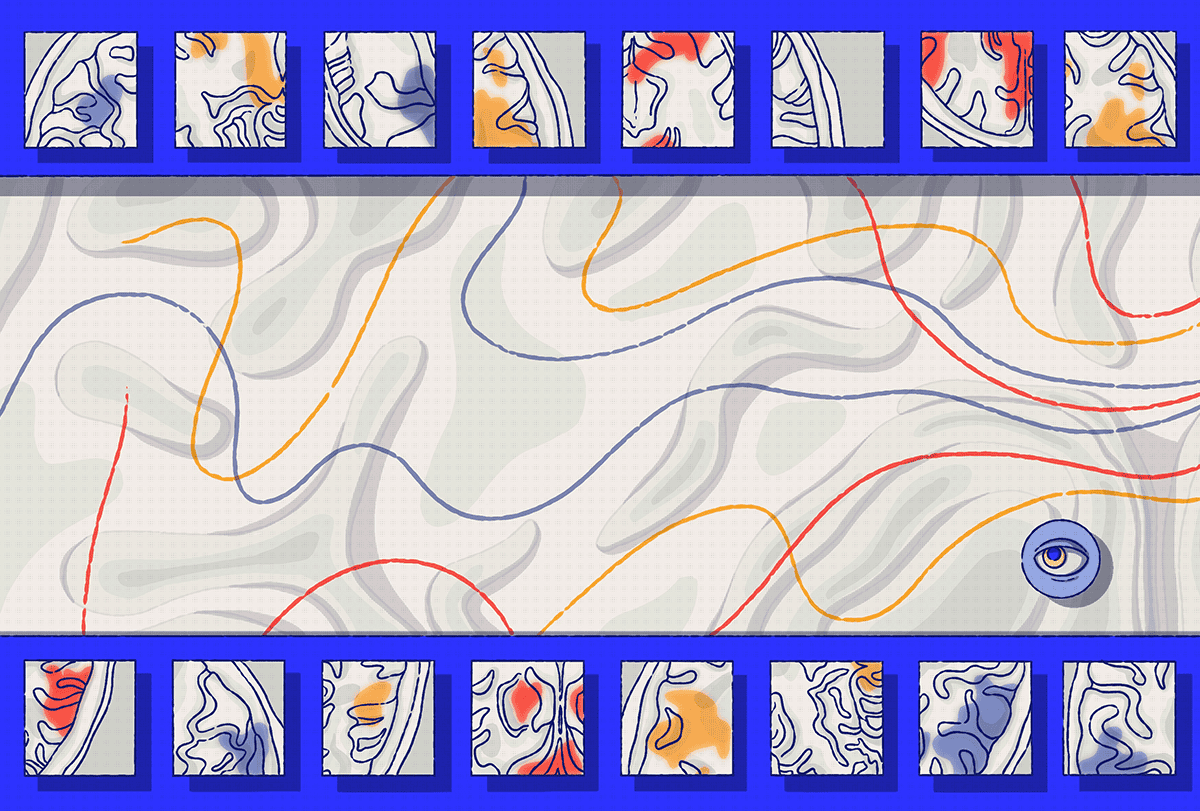
Regional mapping: Functional MRI data collected from people performing various auditory and visual attention tasks helped reveal the directionality of neuronal signaling across the brain.
Illustration by
Yihui Chang
Add us as a Preferred Source on Google
Set us as a Preferred Source to see The Transmitter more prominently in your Google Search results.
This paper changed my life: The salience network makes its mark
Vinod Menon’s 2008 PNAS paper found that activity in the salience network allows the brain to switch between different areas that control cognitive processing. The work drove Uddin to focus her research on large-scale brain networks and interactions among them.
By
Lucina Q. Uddin
17 November 2026 | 4 min read
Answers have been edited for length and clarity.
What paper changed your life?
A critical role for the right fronto-insular cortex in switching between central-executive and default-mode networks. Sridharan D., Levitin D.J., Menon V. Proceedings of the National Academy of Sciences (2008)
This paper was the first to show that activation of the right fronto-insular and anterior cingulate cortices—otherwise known as the salience network—plays a causal role in the brain’s ability to switch activity between different networks that control cognitive processing.
The authors analyzed functional MRI data collected in people performing various auditory and visual attention tasks, as well as during resting state, to investigate the directionality of neuronal signaling across the brain. The analyses revealed that across conditions, the salience network acts as a causal outflow hub that drives activity in the central executive and default mode networks.
The now-ubiquitous triple-network model of salience detection, attention orienting and cognitive control that came from these findings has had an outsized influence on psychiatry and neurology, where researchers use it to explain atypical brain function in multiple brain conditions.
When did you first encounter this paper? Why is it meaningful to you?
I first encountered this paper when I began working as a postdoctoral fellow in Vinod Menon’s lab at Stanford University in 2008. This line of work from the lab got me interested in joining the team!
I was working on trying to understand brain signatures of autism and was puzzled by some findings from my collaborators that involved insular cortex activation. I read this paper with great interest; it helped me come up with a model of brain network dysfunction in autism that I subsequently converted into my first National Institutes of Health grant—a career development award to study structural and functional connectivity of large-scale brain networks in autism.
How did this paper change how you think about neuroscience and influence your scientific trajectory?
This research shifted my thinking from trying to identify specific brain regions related to clinical conditions to focusing instead on large-scale brain networks and interactions among them. It set me on a path to conduct follow-up studies of how the salience network typically develops and its role in autism. The paper that Menon and I published in 2010 summarizing some of these ideas has been cited thousands of times. I don’t think either of us predicted how much interest there would be in our new model of large-scale brain network dynamics when we first came up with it.
I recently met Sridharan Devarajan, the first author on the paper, during a visit to India. He directs a lab at the Indian Institute of Science in Bengaluru. He is an extremely humble individual and was surprised when I described to him what a dramatic influence his findings have had on psychiatry and neuroscience.
What new progress has been made since this paper was published?
Since the paper was published nearly two decades ago, researchers have used its findings to understand how atypical salience attribution—that is, how we assign importance to things—and attention allocation contribute to neuropsychiatric conditions ranging from autism to schizophrenia to frontotemporal dementia. I know that the network models that arose from the findings in the Devarajan paper have influenced researchers studying anxiety and depression and addiction and pain. I think it’s interesting that many researchers claim that the signals from the insula and anterior cingulate provide unique markers for their clinical condition of interest, when it is becoming increasingly clear that the salience network is involved in many different conditions.
There has been a great deal of progress using other techniques to verify the original fMRI findings. For example, human intracranial recording studies have verified that information flows in one direction from the salience and other networks. And studies using fiber photometry in rodent models show causal outflow from the anterior insula. It’s really exciting to see how far things have come over the past decades.
Explore more from The Transmitter
How does the developing brain make so many different types of neurons?
By
Kevin Mitchell
16 November 2026 | 4 min read
The term ‘model organism’ should be reserved for biological systems
By
Marc Coutanche
13 November 2026 | 6 min read
Cite this article: