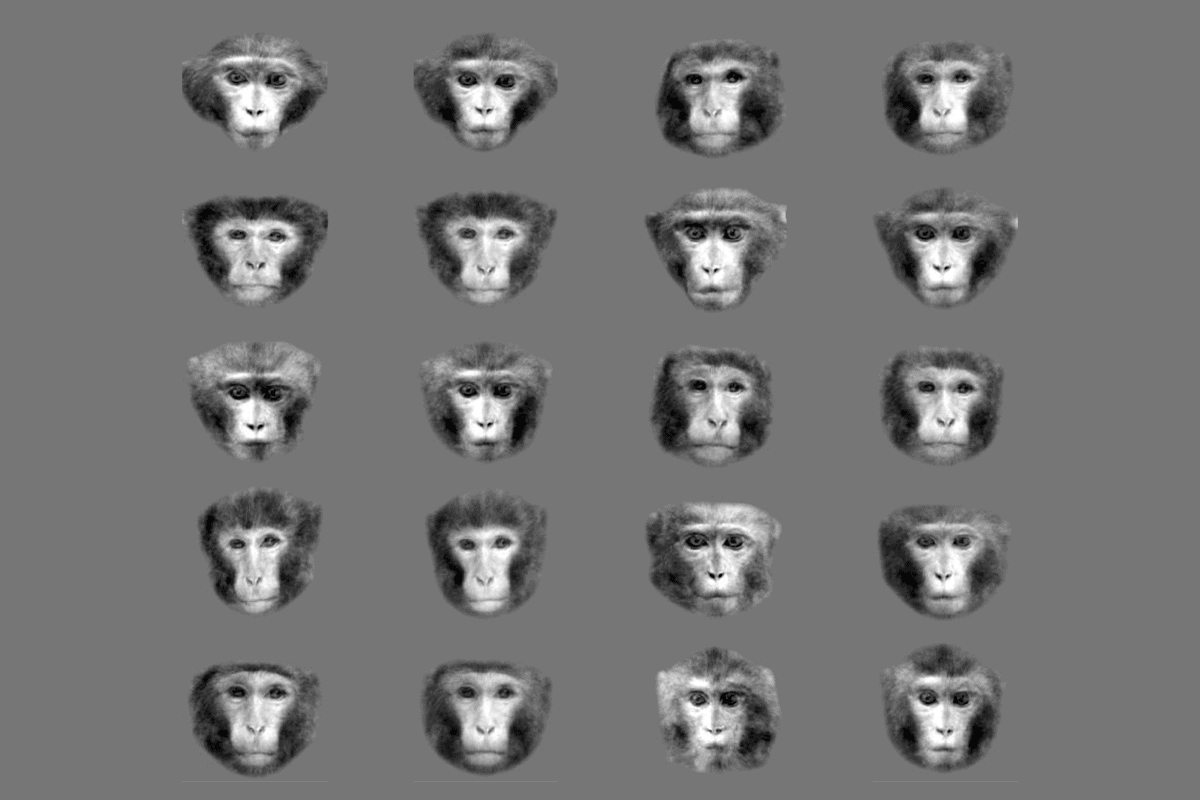
When two eyes are shown different images, the brain usually cannot merge them. So perception settles on one image at a time and alternates every few seconds, a phenomenon known as binocular rivalry.
Even when perception is steady, though, the brain is doing something far faster outside of awareness, new findings in macaques and people suggest: A population of neurons in the inferotemporal and prefrontal cortices takes turns representing the perceived and suppressed images roughly every 60 milliseconds.
The result helps explain why neurons in the inferotemporal cortex that respond to faces fire less intensely to a face when each eye is shown a different image than when both eyes see the same face, says study investigator Doris Tsao, professor of molecular and cell biology at the University of California, Berkeley. (Tsao notes that she completed this work outside of her role as chief scientist at Astera Neuro, a research program of the Astera Institute, a private nonprofit organization.)
“It’s not just that there’s an area in the brain that purely codes whatever you see consciously,” Tsao says. “The cells are alternately coding what you consciously see and what you don’t consciously see.”
The findings don’t show that conscious awareness flickers on and off, Tsao says. Instead, the study offers insight into “one piece of the mechanism for conscious access,” says Tsao, whose team shared the findings in a preprint posted on bioRxiv last month and plans to submit the work to a journal.
The inferotemporal cortex sits near the top of the visual hierarchy and was largely thought to represent only what an animal sees. “The fact that the circuit is switching between the two stimuli is fascinating and unexpected,” says Blake Richards, associate professor of computer science and of neurology and neurosurgery at McGill University, who was not involved in the work. “I wouldn’t have guessed that.”
It remains unclear whether this alternation determines what a monkey consciously perceives, says Aran Nayebi, assistant professor of machine learning at Carnegie Mellon University, who was not involved in the work. To establish that, researchers would need to disrupt the brain’s ability to switch back and forth between the two images and show that perception breaks down even as the cortex still encodes the image, he adds.
“I think that the preprint itself has more to do with image recognition or perception of face-based stimuli than it has anything to do with conscious awareness,” Nayebi says. Although the study builds on Tsao’s past work, “it’s not an advance when it comes to consciousness science.”
T
he new study grew out of “wanting to understand [the] neural mechanism for how a representation becomes conscious,” Tsao says. “Consciousness is one of the deepest questions in all of science.” Bistable illusions, such as Rubin’s vase—in which viewers alternately see a vase or two faces in profile—suggest that conscious awareness is the result of an active process in which the brain selects one interpretation of an ambiguous image out of all possible ones at a moment in time, Tsao says.Tsao and her colleagues leveraged a phenomenon known as binocular flash suppression to reliably control which of two competing images—pairs of human faces appearing in quick succession on a screen—14 human viewers consciously perceived. Because the participants wore anaglyph goggles—akin to the 3D glasses used for watching vintage 3D movies—they saw a different face in each eye. Perception switched to the second face in 82 percent of trials, the participants reported, suggesting that the new face temporarily suppresses the other from conscious awareness, even though both stay on screen.
Two male rhesus macaque monkeys wore the same glasses and viewed images of monkey faces while Neuropixels probes recorded face patch neurons in their inferotemporal and prefrontal cortices. The population activity switched between two states about every 60 milliseconds, the researchers found. From activity in one state, the researchers successfully reconstructed the consciously perceived face, and from the next they reconstructed the suppressed face.
“We were just really shocked,” says study investigator Janis Hesse, a postdoctoral researcher in Tsao’s lab. “This was the strongest evidence that [the system] is actually alternating in time.”
“It’s interesting from the perspective of understanding the biological basis of access consciousness,” which is the information that a person can report and act on, Richards says. But “that’s different from phenomenological consciousness, [or] why do we have subjective experience?” Richards says.
The study doesn’t tackle subjective experience, Hesse says. But because the monkeys don’t report on what they see, it isn’t purely about access consciousness, either. “Maybe we’re inching a bit closer to phenomenological consciousness, but [we’re] not saying we’re any closer to solving it.”
The result shows that what is accessible to conscious readout “is not simply a function of what is getting represented in your higher-order visual stream,” Richards adds. “There must be some other downstream system that is somehow paying attention to one of the representations and not the other.” That could be “top-down modulation coming into the apical dendrites,” he says, or “some other kind of modulation of the output pathways.”
Tsao says she doesn’t see the mechanism that’s selecting what enters our conscious perception as downstream of the inferotemporal or prefrontal cortices. That mechanism is “probably like a loop,” she says, “where consciousness is the result.” But the mechanism of how the brain builds this stable percept is unknown.
Next, the researchers intend to record from the primary visual cortex to see whether the alternation begins there, where input from the eyes first arrives, Tsao says. Their ultimate goal is to control which image an animal sees: “If you really understood the mechanism for conscious selection, you should be able to totally control that,” she says.