Add us as a Preferred Source on Google

Organoids missing the TSC2 gene form rogue astrocytes; and more

Here is a roundup of autism-related news and research spotted around the web for the week of 28 September.

By Jill Adams
29 September 2026 | 2 min read

Two roads diverge: Human brain organoids missing the gene TSC2 have overreactive astrocytes that are similar to those found in tubers from people with tuberous sclerosis complex, according to a new study. The findings substantiate the idea that glial pathology results from altered protein expression and activity—specifically, high mTORC1 signaling—rather than from seizures themselves. “These results implicate glial dysfunction as a driver of TSC pathogenesis and highlight reactive astrocytes as potential therapeutic targets for TSC-related neuropathology,” the investigators write.

Autism research spotted this week:

  • “Postnatal maturation of putamen microstructure accompanies topographic white matter connectivity and altered circuits in autism” bioRxiv
  • “A retinoic acid autoregulatory loop governing prefrontal-motor arealization” Nature
  • “Developmental cerebellar pathology in mouse models of SCN2A premature termination codon variants” bioRxiv
  • “Maternal-fetal immune conflict contributes to male-specific impairments in a mouse model of neurodevelopmental disorders” Science Advances
    See also: “Post-infection immune conflict alters fetal development in some male mice”
  • “Parvalbumin interneurons and dentate gyrus homeostatic dysregulation shape epileptogenesis in Angelman syndrome model mice” bioRxiv
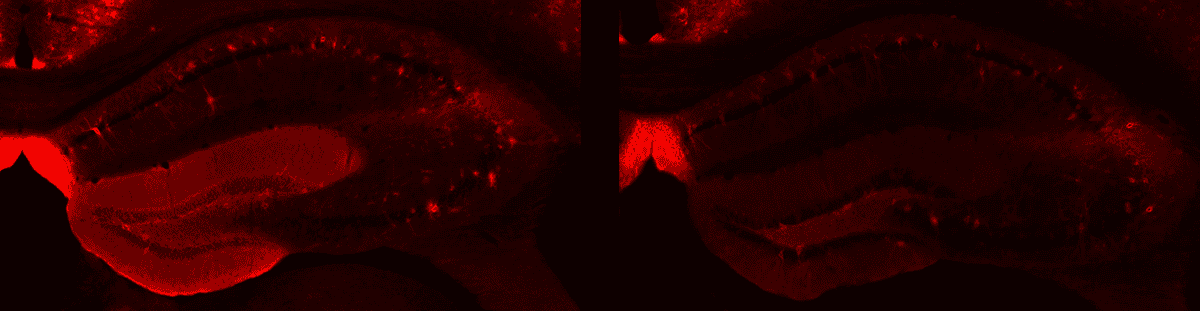
Research image of perineuronal nets.
Seizure susceptibility: Atypical accumulation of perineuronal nets (red stain) in the dentate gyrus occurs with seizure kindling in a mouse model of Angelman syndrome (left panel) but not in mice that have UBE3A present in GABA-containing neurons (right panel).
  • “The uneven landscape of cognitive domains in 22q11.2 deletion syndrome: A large consortium study” Psychological Medicine
  • “A cell type-specific switch in GluN2D NMDA receptors drives cortical circuit hyperexcitability and sensory-driven cortical synchronization deficits in a fragile X syndrome model” Biological Psychiatry
  • “A rare recurring gain-of-function variant in BMPR2 causes neurodevelopmental phenotypes in humans and flies” American Journal of Human Genetics
  • “Congenital TORCH infections and neurodevelopmental outcomes” JAMA Pediatrics
  • “Kennedy announces new effort to speed up autism diagnoses” STAT
  • “Molecular biologist and neuroscientist Catherine Dulac wins the 2026 Pearl Meister Greengard Prize” Rockefeller University

Sign up for the weekly Spectrum newsletter.

Stay current with the latest advancements in autism research.