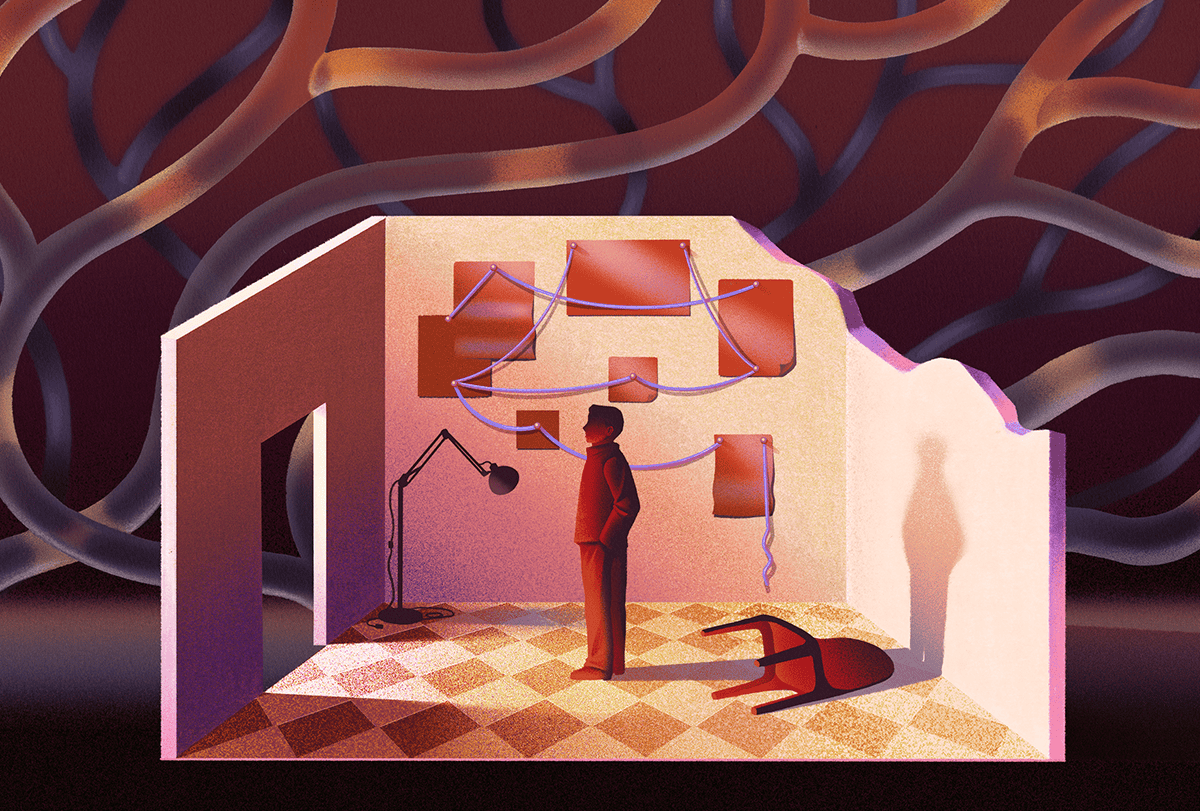
Illustration of a person standing in a crumbling room with papers and strings on the wall, a fallen chair, and a lamp.
Holistic view: Rather than trying to decompose a complex distributed system into component parts, researchers may need to to embrace its complexity.
Illustration by Ada Shen
Add us as a Preferred Source on Google

What to do when traditional mechanistic approaches no longer work

Many complex behaviors have stubbornly resisted mechanistic explanations. Deciphering them will require new approaches—and perhaps a new concept of “understanding.”

By Bence Ölveczky
19 October 2026 | 8 min read

Our worldview is mechanistic, so naturally we want our explanations to be too. That’s why, when faced with a complex system such as the brain, we break it down into parts and build understanding by accounting for each part and how all those parts interact. When it works, as it did early in my neuroscience training, it can be incredibly satisfying. I studied how the retina processes motion and how zebra finches sing. I could trace the signals from photoreceptors to ganglion cells, or from one specialized song nucleus to the next, and watch a complex circuit computation reveal itself as a sequence of simpler operations, each accounted for by the properties of the neurons and their connections. It gave me real intuition. 

Emboldened by these successes, I wanted to take my game to the big leagues and take on how the cortex works. The ensuing journey has tested my ideas about what constitutes “understanding” in neuroscience and forced me to consider new ways of getting there, especially for complex behaviors that have stubbornly resisted mechanistic explanations.

To get at the cortex and its interactions with the rest of the brain, I decided to study skill learning in rats. I reasoned that rats are basically furry songbirds, so whatever worked before should work again. But probing the mammalian motor circuit presented an uncomfortable new reality. Neural activity, however well we characterized it, no longer spoke directly to what the circuits were doing: Two regions that we had shown by lesions to make very different contributions to a behavior carried near-identical representations. And acute neural manipulations—silencing cells with optogenetics, for example—didn’t offer much help either. They told us how the perturbed system responds, not what the targeted region computes.

What had changed? I realized that the retina and the birdsong circuit shared two features essential to my early successes. First, these circuits evolved to solve specific, well-defined tasks. The well-delineated anatomy of specialized circuits often reads like an instruction manual, complete with a parts list and ready-to-test hypotheses. Second, the computations in these circuits can be well approximated as sequential and feedforward, making it relatively straightforward to relate neural activity to circuit function: Signal comes in, gets transformed in stages and goes out. The way it is reshaped at each stage tells you what that stage computes. The alignment between the circuit’s structure, its computational function, and how this function manifests in neural activity yields a compelling mechanistic account of what the system does.

The circuits in the cortex and striatum that I was now trying to decipher function differently. Instead of the circuits being dedicated to a specific task, evolution shaped them for flexibility, making them general-purpose circuits that can be recruited for whatever the animal is doing. One circuit, many tasks, many contexts. Maybe a good trade for the animal, but a terrible one for the experimentalist. It’s not that these circuits are short on structure: The cortex is exquisitely layered; the striatum has its cell types and topography. But the manual and parts list are impossible to read. You can stare at the layers and the cell types for a long time without arriving at a hypothesis crisp enough to be wrong. In circuits designed to serve many tasks, there is no decomposition that cleanly maps onto any one of them.

When you probe these general-purpose circuits with a complex motor task—as I did—things get even more entangled. The circuits need to track not just which task they have been recruited for but also how they are doing moment to moment so they can adjust when things change. That is what recurrence—so prominent in these circuits—is for. But it also makes their activity a difficult thing to parse. Gone is the sequential input-output transformation of feedforward circuits. The activity is now the result of the circuit’s own output returning in altered form after passing through many other parts of the brain. Every area is bathed in the same circulating signal, and that shared component can swamp the private one, which is why my two regions, doing demonstrably different jobs, carried near-identical representations.

And if that isn’t enough, you also have to contend with the fact that the loop runs through the body, a nonlinear inertial system with its own dynamics and constraints. The urge to decompose such a complex distributed system into manageable chunks is hard to resist, but the reductionist approach stops paying out. Cut a feedforward chain, and you get two parts, each still a system you can observe and probe on its own terms. Cut a loop, and you just get a broken loop.
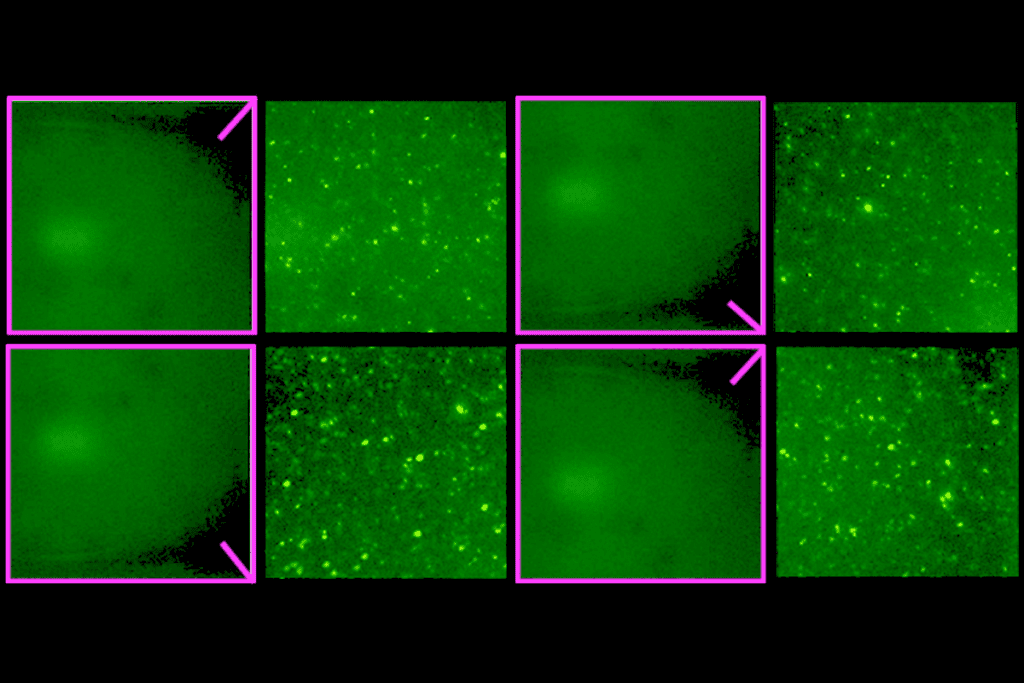

Virtual rodent: Researchers trained an artificial neural network controlling a biomechanical model to imitate the behavior of a real rat.
Credit: Kristian Herrera

T

his doesn’t mean recurrent circuits lack anatomically localized functions. Indeed, identifying them is one of my lab’s main goals. From a distance, we can make them out. When we lesion a brain area, we get a specific behavioral signature telling us what that region contributes once the system has equilibrated. It fits nicely into a modular mechanistic picture. But when we go closer and record or manipulate its activity in real time, this picture vanishes like a mirage. Even if specific computations can be localized to a given brain area, its neural dynamics will reflect the ongoings of a much larger distributed network. The alignment across levels of analysis—structure, dynamics and function—has become a casualty of the multipurpose and recurrent nature of the circuit.

How do we recover that alignment? Rather than reducing the system’s complexity, maybe we should embrace it. Don’t cut it up; just deal with the hairy whole. If so, neuronal population dynamics—a property of that whole—is a good place to start. With the right math, we can parse the dynamics and recover a surprising amount of modularity. Rotations, attractors and low-dimensional manifolds become our new objects of description. With some luck and finesse, we can map them to elementary computations and recast complex behavior as a sequence of transitions across neural state space. We have traded structural reductionism for a functional one. In making that bargain, though, we lost mechanistic intuition. The dynamical account, however rigorous and compelling, does not reference the substrate that does the work.

To work our way back to a mechanistic explanation, we need to align population dynamics and function with the underlying biology. This will require accounting for how cellular mechanisms, circuit motifs and specific brain areas contribute to those dynamics and the functions they support. No experiment I can conceive of in a real animal will let us do this in a clean and comprehensive way.

Are we toast? Maybe not. The field is rapidly developing tools to create virtual animals, complete with realistic biomechanics and artificial neural networks for brains. Such critters—informed, constrained and validated by experiments in real animals—can be brought to “life” in a physics simulation. These so-called “digital twins” are fully observable, fully manipulable and endlessly repeatable. They enable us to perform system identification without tired excuses about methodological limitations. Importantly, we can systematically alter the network’s connectivity and unit properties to probe how they give rise to dynamics and behavior. 

My lab has built virtual rats and trained them to solve tasks akin to those we challenge our rats with. By comparing their “brains” to real ones, we have learned things about biological motor control that we could not have learned from measurements alone. My hope is that virtual animals will help us gain intuition about how structure, dynamics and function are related in recurrent neural systems that control complex bodies. If that promise holds, we can use what we learn from virtual animals to formulate testable hypotheses in real ones and chart the experimental road map that will get us to mechanistic understanding.

I don’t think it’s just me. I see our whole field yearning for mechanistic models; they have provided intuitive and satisfying explanations for much of what the brain does—just not in the regime I waded into when taking on the cortex. This regime of recursion, flexibility and embodiment is not a curiosity at the edge of the field; it is where anything we would want to call intelligence lives. Whether digital twins will help deliver a mechanistic understanding of how such systems function or whether we will need a new, yet-to-be-discovered explanatory framework, I don’t know. But we have no choice but to find out.

AI use disclosure:

The author used Claude to query the text for clarity and identify potential points of confusion. All text and arguments are the author’s own.

Sign up for our weekly newsletter.

Catch up on what you missed from our recent coverage, and get breaking news alerts.