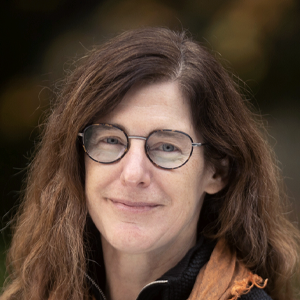
Headshot of Adrienne Fairhall.

Adrienne Fairhall

Professor of physiology and biophysics, University of Washington;
Contributing editor, The Transmitter

Adrienne Fairhall is professor of physiology and biophysics and adjunct professor of physics and applied mathematics at the University of Washington in Seattle. She co-directs the Computational Neuroscience Program at the University of Washington with Eric Shea-Brown. Her work focuses on dynamic neural computation, with a particular interest in the interplay between cellular and circuit dynamics and coding in a wide variety of model systems, including Hydra, Drosophila, birds and primates.

Fairhall obtained her honors degree in theoretical physics from the Australian National University and her Ph.D. in statistical physics from the Weizmann Institute of Science. She received her postdoctoral training at the NEC Research Institute with Bill Bialek and at Princeton University with Michael J. Berry II.
Explore more from The Transmitter

Research image of variants of the ATPase subunit PSMC5/RPT6.

Insights on suicidality and autism; and more

Here is a roundup of autism-related news and research spotted around the web for the week of 8 December.

By Jill Adams
9 December 2025 | 2 min read
A stack of papers topped by many paper shreddings against a red background.

Exclusive: Springer Nature retracts, removes nearly 40 publications that trained neural networks on ‘bonkers’ dataset

The dataset contains images of children’s faces downloaded from websites about autism, which sparked concerns at Springer Nature about consent and reliability.

By Calli McMurray
8 December 2025 | 5 min read
Research image of a virtual environment simulating an animal’s viewpoint close to the ground.

Seeing the world as animals do: How to leverage generative AI for ecological neuroscience

Generative artificial intelligence will offer a new way to see, simulate and hypothesize about how animals experience their worlds. In doing so, it could help bridge the long-standing gap between neural function and behavior.

By Shahab Bakhtiari
8 December 2025 | 8 min read

privacy consent banner

Privacy Preference

We use cookies to provide you with the best online experience. By clicking “Accept All,” you help us understand how our site is used and enhance its performance. You can change your choice at any time. To learn more, please visit our Privacy Policy.