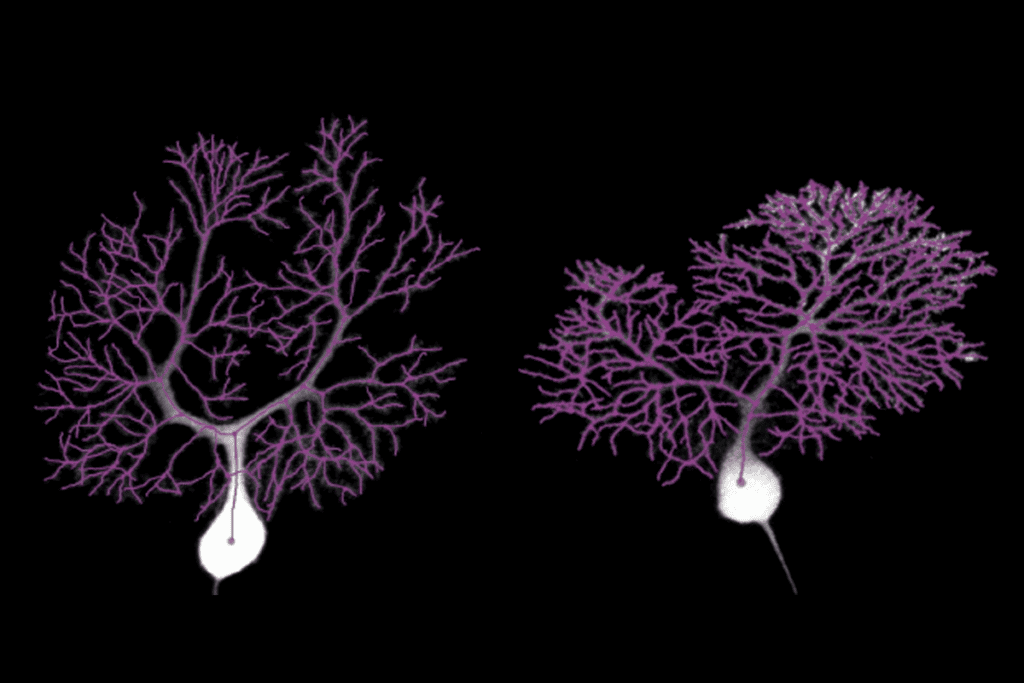
Write and read: The technique recorded activity in six regions of the mouse visual cortex while stimulating approximately 150 neurons in the center of area V1.
A new platform enables researchers to simultaneously read and write neuronal activity with near single-cell resolution across large areas of the mouse cortex using only light.
The two-photon holographic mesoscope, the first of its kind and described in August in Nature Neuroscience, manipulates neuronal activity with high precision in one region while recording activity in other, downstream areas. The tool could help address long-standing questions about information transmission between brain regions and how this relates to perception, cognition and behavior.
The approach makes it possible to stimulate specific cells by combining optogenetics with computer-generated holography, which uses spatial light modulators (SLMs) to create precise 3D illumination patterns. The holography provides the write capability, while genetically encoded indicator proteins that fluoresce when neurons fire provide the read capability.
But holography targets a limited field of view (FOV)—an area of less than 2 millimeters squared, depending on the size and number of pixels, which has confined previous studies to questions about local processing or, in the case of two 2023 studies, short-range interactions between two adjacent areas.
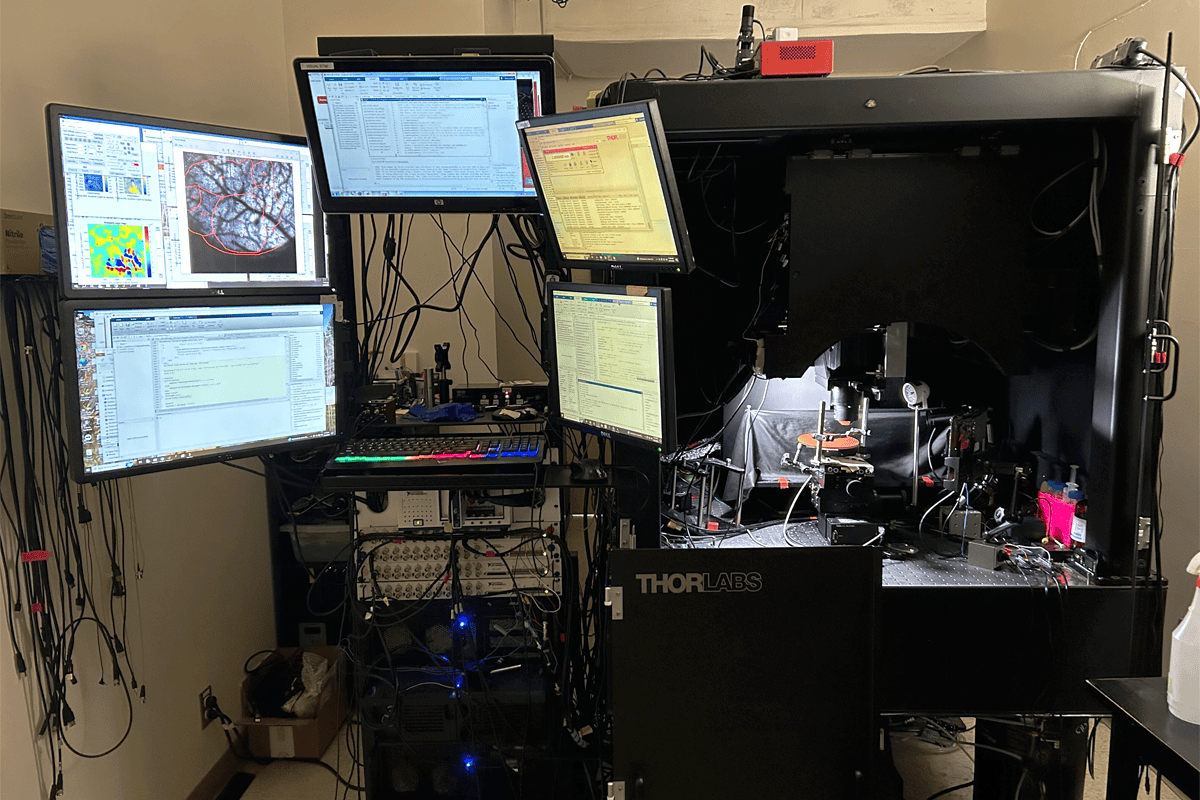
So for the new platform, the team designed an optimized holographic system that they integrated into an off-the-shelf two-photon mesoscope, which can record neuronal activity across up to 5 millimeters squared, making it possible to read from multiple areas.
“The major result of this paper was to combine holography with mesoscopy, which had not been done before,” says Valentina Emiliani, head of photonics at the Institut de la Vision, who was not involved in the work. “This was full of challenges, so it’s a big achievement.”
Field of view: The holographic mesoscope (right) can write to one area and record neuronal activity from multiple different areas across up to 5 millimeters squared.
COURTESY OF CONOR DORIAN
T
he researchers used the new platform to stimulate groups of neurons in four areas of the mouse visual cortex, one after another, while recording the activity of thousands of neurons in six surrounding areas.
“It’s the first time we’ve been able to activate specific ensembles in one cortical area and map the functional impacts across three, five or even six other cortical areas,” says study investigator Hillel Adesnik, professor of neuroscience at the University of California, Berkeley. “And there were some interesting results.”
In one experiment, for instance, the researchers trained a machine-learning classifier to discriminate between activity patterns evoked in the visual cortex of mice while they viewed four different orientations of alternating black and white parallel lines. After identifying neurons in visual area V1 tuned to each of the four orientations, the team stimulated groups of these cells and showed that the classifier could categorize downstream activity as the correct orientation significantly above chance. This suggests the platform can write activation patterns that transmit visually relevant information between regions.
“I’m excited about figuring out how do we design these excitation patterns to maximally communicate this information?” says Sean Quirin, assistant professor of psychiatry and behavioral sciences at Stanford University, who was not involved in the work. “They have everything demonstrated here to knock on that door.”
Constructing maps of functional connectivity between areas requires rapidly stimulating neurons in different regions while recording activity from several surrounding areas. The team tackled this challenge by incorporating an arrangement of mirrors that quickly repositions the stimulation anywhere within the mesoscope’s FOV. This tactic increased the accessible stimulation area by an order of magnitude, says study investigator Lamiae Abdeladim, a postdoctoral researcher in Adesnik’s lab.
This arrangement made it possible to stimulate two different visual cortex areas while recording across the whole mesoscope FOV and derive connectivity maps from the responses. Local activity was primarily inhibitory, replicating findings in previous studies, but the team also found that the effect on activity in different regions was more excitatory, which is a new finding.
This work was not an attempt to derive exhaustive maps, or biological interpretations, so much as to demonstrate the platform’s capabilities, Abdeladim says. “Being able to perturb functionally defined ensembles of neurons across multiple cortical areas was not possible by any other technique,” optical or not, she says. “That opens a new class of causal experiments for neuroscience.”
These results “scratched the surface on a bunch of questions, to whet the appetite of the community to take this further,” Quirin says. “These are the tools necessary to start asking questions about how information propagates through these systems, to tease out the language of the brain.”
Abdeladim says she and her colleagues hope that using a commercially available mesoscope will help other groups adopt the platform. Its capabilities could improve as the underlying technologies advance, she adds. For instance, increasing SLM pixel density would expand the FOV of optogenetic holographic stimulation.
Larger FOVs may help scale two-photon optogenetics to animals with larger brains, such as nonhuman primates, Adesnik says. Another application could be improving brain-machine interfaces, Quirin says. “The question is, can we figure out what’s important for communication, then use that to inform brain-machine interfaces?” he says. “Ultimately, the hope is that whatever we’re learning here is going to help patients, because neuromodulation is increasingly becoming clinically relevant to helping people live better lives.”